A few years back, I sat across from a Lakeland operations leader who looked completely worn out. They weren’t being dramatic; they were doing what most local employers do when the work keeps coming and the team can’t keep up. They’d been running overtime for weeks, supervisors were hopping on the floor to cover gaps, and the HR inbox was a revolving door of applicants who didn’t show up for interviews or didn’t last past the first week. The company wasn’t trying to “grow fast.” They were simply trying to meet the schedule and protect quality without burning out the people they already had.
When we started talking numbers, the story got even more familiar. They were focused on what hiring “costs,” meaning ads, background checks, and a recruiter’s time. What they weren’t tracking was what the vacancy itself was costing them every day: the overtime premium, the slowed production line, the rework, the late shipments, the customer frustration, and the quiet attrition that happens when good employees get tired of carrying an empty position. That conversation is exactly why I’m so direct with employers about staffing. The value of working with a staffing partner isn’t a vague promise. It’s a practical way to control the hidden costs that pile up when hiring drags on.
If you’ve heard that staffing companies are “more expensive,” you’re not alone. But “expensive” compared to what? The Society for Human Resource Management (SHRM) has reported an average cost per hire of nearly $4,700, and that figure doesn’t even pretend to capture everything a vacancy does to productivity. SHRM has also shared that replacing an employee can range from 50% to 200% of their annual salary depending on level, once you account for recruiting, ramp-up time, and lost output. When you compare staffing fees to those realities, the conversation changes from “How much is the markup?” to “How do we stop the bleeding?”
Lakeland is a special market, and not just because it sits in the middle of two major metros. Local employers compete in a region shaped by distribution, warehousing, transportation, healthcare, education, and manufacturing. That mix creates real opportunity, but it also creates real competition for dependable talent—especially for roles that demand attendance, safety awareness, and consistency.
Economic development sources point to supply chain and logistics as a major driver in the area, including significant industrial and warehouse capacity and large employment tied to that sector. The employer landscape reflects it, too. Polk County’s major employers include organizations like Publix, Lakeland Regional Health, Walmart, and Amazon—exactly the kinds of companies that influence wage expectations, shift preferences, and candidate flow across the region.
Then there’s the labor market temperature itself. CareerSource Polk reported a 5.5% unemployment rate for Polk County in December 2025, with notes on how it compared to the state rate at that time. Whether unemployment is higher or lower in a given month, employers still feel the same day-to-day truth: the best-fit candidates have options, and time-to-fill can quietly become time-to-lose if you don’t move quickly and confidently.
This is the backdrop for why staffing companies in Lakeland Florida exist in the first place. In a market where the work is steady and the competition for reliable people is steady, a staffing partner isn’t a luxury. For many employers, it’s a way to keep labor costs predictable and performance stable.
One of the biggest misconceptions I hear is that staffing firms “just send resumes.” A good staffing partner does far more than forward applicants. The American Staffing Association describes staffing firms as providers of workforce solutions across temporary, contract, and other arrangements that help businesses access talent and flexibility. In practice, that means a staffing company is often taking work off your plate that you’re currently paying for with internal time, overtime, and risk.
At a basic level, staffing firms recruit, screen, interview, and verify candidates to match your job requirements and work environment. They coordinate scheduling, confirmations, and the constant follow-up it takes to turn “interested” into “start date.” They manage the details that can derail an otherwise good hire, like incomplete paperwork, missed drug screens, or confusion about shift expectations.
Depending on the arrangement, staffing agencies also handle key employer-of-record responsibilities. The American Staffing Association notes that staffing agencies and clients generally share employer obligations, with staffing agencies paying wages, benefits, and employment taxes, along with unemployment and workers’ compensation insurance, while clients supervise the employee’s work and provide a safe work site. That co-employment structure is one of the most important “expectation-setting” points for local employers, because it helps clarify what you can lean on your staffing partner for, and what still lives with your business day-to-day.
The simplest way to think about it is this: you keep control of the work, standards, and culture on site. Your staffing partner builds and manages the hiring engine behind the scenes, and in many cases carries major administrative and insurance responsibilities that otherwise sit fully on your payroll.
Let’s tackle the uncomfortable truth: staffing bill rates can look higher than a direct wage. That’s the moment when employers assume staffing is a premium option. But the bill rate is not the wage. It’s the wage plus a bundle of costs you already pay—just not always in one obvious line item.
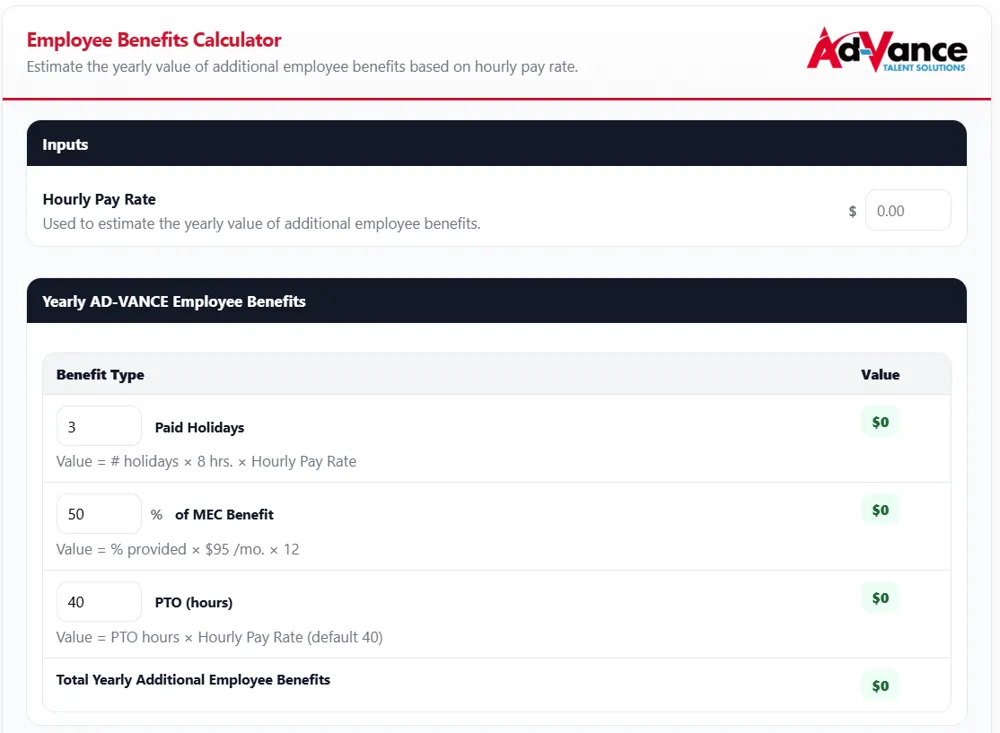
For example, benefits are a real share of employment cost. Reporting that references federal compensation data shows that wages and salaries make up a little under two-thirds of employer compensation costs, while benefits make up a little over one-third. Even if you don’t offer rich benefits for every role, you still have mandatory costs like employer payroll taxes, unemployment insurance, and workers’ comp exposure, plus the administrative time it takes to manage all of it.
Embed calculator from this link: https://www.ad-vance.com/employee-benefits-calculator.
Then you have recruiting costs. SHRM’s reported average cost per hire near $4,700 is a benchmark employers often underestimate because it’s spread across job ads, recruiter time, interviewing, systems, and onboarding. On top of that, turnover is where businesses really get hit. When SHRM notes replacement costs ranging from 50% to 200% of salary depending on the role, that’s not meant to scare you—it’s meant to reflect the compounding reality of lost productivity, training time, and performance ramp-up.
Staffing saves money when it helps you avoid the costs that come from vacancies and bad-fit hires. The big wins typically come from reducing overtime, stabilizing output, improving attendance, and shortening the time between “we need someone” and “they’re actually here and productive.” In Lakeland, where shift-based operations and customer commitments are common, those wins show up fast.
If you’re comparing staffing companies in Lakeland Florida, you’ll hear the markup conversation early. Here’s the healthiest way to approach it: treat staffing pricing like an all-in labor cost that includes services, risk, and speed—not just like a wage comparison.
In many temp and contract arrangements, the staffing firm’s bill rate typically covers the employee’s pay, employer payroll taxes, unemployment insurance, workers’ compensation, and the recruiting and administrative infrastructure required to keep candidates flowing. It also covers the fact that staffing partners carry real risk. When a person no-shows, quits, or isn’t a fit, a good staffing partner doesn’t shrug and wish you luck. They replace, adjust, and keep working the pipeline because your operation can’t pause.
That’s why the best pricing conversations aren’t “What’s your markup?” but “What is included, what is guaranteed, and how quickly can you deliver quality?” A lower bill rate that produces churn is often more expensive than a higher bill rate that produces stability.
Staffing is not only for massive companies, and it’s not only for employers who are expanding. In my experience, the employers who benefit most are the ones who feel the cost of downtime the fastest and the ones who can’t afford hiring surprises.
If your business runs shifts, staffing can protect you from the weekly scramble caused by absences and resignations. If you’re in a safety-sensitive environment, staffing can help you tighten screening and reduce the risk of a bad hire slipping through because the team is desperate. If you’re a smaller business without a dedicated recruiting function, a staffing partner can give you access to a consistent talent pipeline without adding internal headcount.
And if you’re somewhere in the middle—an HR team juggling benefits renewals, employee relations, and compliance—staffing can be a pressure release valve. It lets HR focus on the employees you already have while your staffing partner handles the churn-prone roles that consume time.
This is why “hiring companies Lakeland” searches often lead employers to staffing firms. The goal isn’t outsourcing your culture. The goal is outsourcing the parts of hiring that are expensive because they’re repetitive, time-consuming, and easy to get wrong when you’re stretched thin.
Some are, and it matters. Many Lakeland staffing firms build expertise around the industries that dominate local demand—logistics and distribution, manufacturing, administrative support, and healthcare-adjacent roles. That local specialization matters because it shapes how recruiters screen. A recruiter who understands pick rates, shift differentials, safety requirements, and seasonal surges will ask different questions and set different expectations than someone hiring for a role they don’t fully understand.
It also matters because candidates can tell when a staffing partner “gets” the job. When expectations are clear up front—physical requirements, schedule, attendance policies, and what success looks like—first-week fallout drops. That’s cost savings you can feel, because every early exit turns into another restart of the hiring cycle.
When you’re evaluating staffing companies in Lakeland Florida, ask whether they have proven experience in your environment, not just in your job title. A warehouse role in a high-volume, scan-heavy operation is not the same as a warehouse role in a slower, forklift-heavy facility. The difference shows up in the match quality.
Here’s another expectation-setting truth: staffing works best when it’s a partnership, not a handoff. Even if your staffing partner is doing the heavy lifting, you still have a role to play if you want cost savings and not just short-term relief.
You need to be clear about what success looks like. Is it speed, attendance, safety, accuracy, customer service, or all of the above? You need to be honest about the work environment, because candidates can handle hard work, but they don’t handle surprises well. You also need someone on site who treats new staffing employees like they matter, because the fastest way to waste staffing spend is to create a revolving door through poor onboarding or inconsistent supervision.
This is where staffing gets unfairly blamed. If a staffing employee doesn’t get trained, doesn’t get feedback, and doesn’t feel part of the team, turnover goes up. And turnover is expensive no matter how you hire, as SHRM’s replacement-cost range makes painfully clear. The staffing firm can bring you talent, but your environment determines whether that talent stays.
It’s tempting to choose a partner based on the lowest rate or the loudest promises. But if your goal is staffing cost savings, the best comparisons focus on outcomes that directly affect your P&L.
Look at speed-to-present and speed-to-start, because every day a role sits open has a cost you can calculate. Look at first-week retention and 30-day retention, because churn is where hiring costs stack up. Look at how the firm recruits locally, how they communicate with candidates, and how they handle attendance issues. Ask how they screen for reliability, not just skill, because reliability is the foundation of productivity in most Lakeland operations.
Also pay attention to transparency. A good staffing partner will tell you what they can do quickly, what might take time, and what tradeoffs exist between speed and selectivity. They’ll also be upfront about what they need from you to improve quality and retention.
If you’re researching staffing companies in Lakeland Florida, you’re probably not looking for a trendy solution. You’re looking for fewer surprises, faster hiring, and a way to stop paying the “vacancy tax” that shows up as overtime, stress, and inconsistency. That’s exactly how we think about staffing at Ad-Vance Talent Solutions. The goal isn’t to flood your site with bodies. It’s to deliver dependable people, set expectations clearly, and create a hiring rhythm that lowers your total cost over time.
If you want to talk through what staffing could look like in your operation—whether it’s temp support, temp-to-hire, or direct hire—Ad-Vance Talent Solutions can help you map the true cost of your current hiring approach and identify where a staffing partnership would save money in the real world, not just on paper.